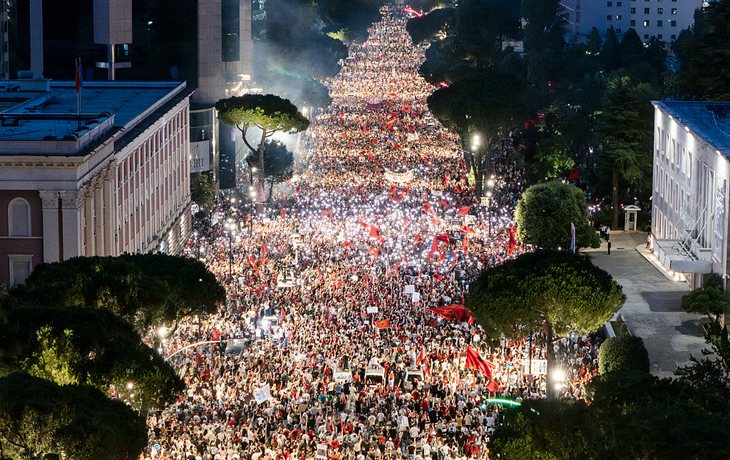
There, in The Hague, the court decision for the four Liberators is awaited. Here, in Albania, an entire people is not simply waiting for a court decision, not simply waiting for freedom for their liberators, but waiting to see if their history will be treated with justice. Can justice be separated from history? This is a great dilemma, so great that it seems to have overwhelmed the Special Court itself. An embarrassment that is easily understood from this trial that has dragged on for several years, as well as from the almost 6 years of detention of the 4 political leaders of the newest state in Europe.
In fact, how could such a process not last and drag on, when the process itself, at the beginning, was conceived of fairy tales with yellow houses, produced by the greatest fairy tale writers of modern Europe, Carla del Ponte and Dick Marti, a duo that, for their unbridled level of fantasy, would envy even the Brothers Grimm.
The judges, in these 3 years of process, thousands of pages of documents and hundreds of witnesses called to the courtroom, must have already understood that the KLA did not arise from nothing, but was born in a Kosovo where genocide, violence and violation of fundamental rights had left no other alternative. For the Albanians of Kosovo, the war was not a choice, but a confrontation with the reality that had reached the limits of existence.
This does not mean that every action committed during the war must be justified. No flag, no uniform, no command, and no cause places a man above the law. If an individual has committed crimes, he must answer for them. If the evidence is not sufficient to prove guilt, then justice must have the courage to say so as well.
But there is a risk that an individual trial will turn into a moral trial of the entire Kosovo war. This should not happen. Because a court decision cannot change the historical fact that Kosovo was under genocide and that the KLA war took place in the circumstances of an armed conflict that brought international intervention and ultimately the liberation of Kosovo. Crimes can be tried, individuals can be punished, but a people cannot be punished for fighting for freedom. Kosovo's war for freedom is the story of thousands of people who took up arms, of families who lost their loved ones, of the exiles, of the martyrs, of the disappeared, of young people who left for the fronts without knowing if they would return, and of a society that demanded the right to live freely.
Waiting for the announcement of the Special's decision, I don't know why, reminds me of the lyrics of a song that is very appropriate for the times we are living in.
…I remember the three letters that brought us the holiday,
I remember the torture, the massacre, the protest,
Don't say the KLA committed crimes in the villages,
because we fought in Kosovo and not within Serbia.
Say what you need to say if you have something to say,
but not for the KLA until June 99...
The truth is that a national aspiration cannot be criminalized because in a war, illegal actions may also have been committed by individuals. The history of a people cannot be placed in the dock with four people. And ironically, history repeats itself time and time again, as if to show forcefully and stubbornly that it should never be forgotten by peoples.
A century ago (May 1881) Abdyl Frashëri and Sulejman Vokshi, the political and military leaders of the League of Prizren, were in Turkish prisons, accused by the Ottoman Empire of having committed crimes during the war for the freedom of their people. In the drama Epoka before the trial of Ekrem Kryeziu, the answer that Abdyl Frashëri gives to the presiding judge is monumental when he asks him why he participated in the war for the freedom of his people… From the beginning, I tell you, I cannot answer only in my own name. I am very small compared to the people, whom you cannot call to trial and condemn as you will condemn me. I have done nothing else, but as a good son, I have followed his opinion…
The leaders of the League of Prizren sat in the dock of the Ottoman Empire. A century later, in another courtroom, the history of Kosovo again awaits the verdict for the people who wrote it with war.
What needs to happen is that, on the one hand, the Court must judge concrete people, on concrete evidence and for concrete responsibility. It cannot replace the historian and, even less, can it give a verdict on an entire people.
On the other hand, whatever it may be, Kosovo must await the Hague decision with dignity. September 16th should not be the day when Kosovo turns its back on justice. It should be the day when Kosovo asks justice not to turn its back on history.
The fight for freedom does not automatically make anyone innocent. But neither does an indictment automatically make anyone guilty. That is why, since it has come to this, the Liberators must be judged by the Special on evidence and facts, while the KLA can and should be judged only by history.
And the history of Kosovo is much bigger than a courtroom in The Hague.