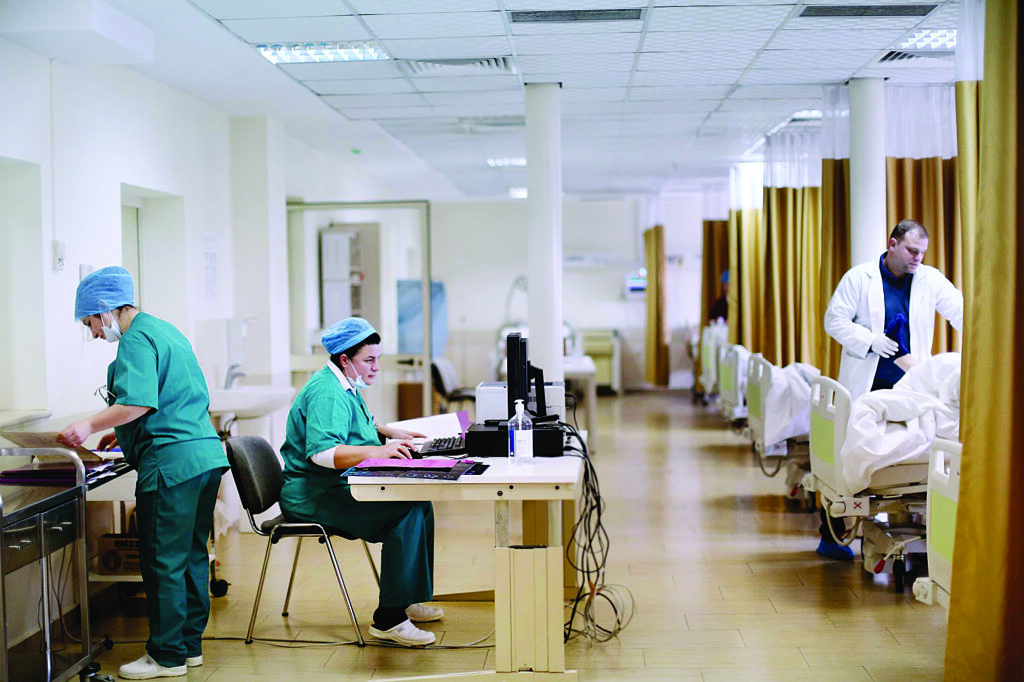
Albania continues to lag far behind the European Union in terms of resources spent on healthcare. The difference is large not only in euros, but remains deep even after eliminating the effect of lower prices in the country.
In addition to the much lower level of real consumption per capita, the Albanian system is also characterized by a much greater financial burden that falls directly on families, who are forced to finance almost half of health expenses out of pocket, as a result of low government spending.
According to Eurostat data for 2025, individual health expenditure in Albania is estimated at 662 euros per capita, compared to an average of 3,675 euros in the EU. (See chart: Nominal per capita health expenditure (euro).
In nominal terms, Albania thus only reaches 18% of the European average in per capita spending. The lowest levels in Europe are in North Macedonia (390 euros).
In total, according to Eurostat, healthcare consumption in Albania in 2025 was 1.56 billion euros. This amount represents 7.7% of current individual consumption, while in the EU healthcare accounts for 13.4%. In the region, Serbia holds the lead, with 11.5%, while the lowest level is in North Macedonia, with 5.8%. (see chart: Healthcare consumption in relation to total individual consumption, year 2025)
This indicator does not only include payments that citizens make directly from their pockets. According to Eurostat's methodology, "Current individual consumption" counts goods and services that are consumed by individuals, regardless of whether they are financed by the families themselves, by the state or by other institutions. For this reason, health also includes services financed by public funds.
The nominal gap with Europe is influenced by prices. The price level of health products and services in Albania in 2025 was only 44.6% of the EU average. As a result, 662 euros in Albania buys more services than the same amount in an average EU country.
However, even after adjusting for price differences, the gap remains deep. Expressed in purchasing power standards, healthcare consumption amounts to around 1,500 PPS per capita in Albania, compared to around 3,700 PPS in the EU. Thus, the real volume of healthcare goods and services consumed per person in Albania is only around 40% of the European average.
As a result, the difference cannot be explained solely by the fact that doctors, tests, medicines or other services cost less in Albania. Even when the comparison is made at equal prices, Albanians have a significantly lower volume of health services and products at their disposal.
The overall indicators of the system's financing also paint a similar picture. According to the World Health Organization database, also published by the World Bank, current healthcare spending in Albania was 7.05% of GDP in 2023. In the European Union, in the same year, it reached 10% of GDP.
Albanians pay much more out of pocket
In addition to overall low health spending, the problem becomes even more apparent when looking at the way healthcare is financed. In Albania, 48.27% of current healthcare spending in 2023 was paid directly by households, according to data from the World Bank. In practice, almost one in every two euros spent on healthcare comes directly from citizens' pockets.
This is the highest level in Europe. In second place is North Macedonia (39.6%) followed by Bulgaria (35.5%). In the region, the lowest out-of-pocket payments are in Montenegro (26.3) - see the graph Out-of-pocket expenses, to total in 2023.
In the EU, direct payments by households accounted for only 14.9% of health spending.
The difference is related to the much greater role of collective financing in EU countries. In 2023, 52.3% of health spending in the EU was financed by mandatory insurance schemes and 28.2% by government schemes. Together, these sources covered 80.6% of the health bill. In Albania, domestic public sources financed about 49.6% of current health spending in 2023./ Monitor