Edi Rama has decreed with his latest stances the first major victim of the flamingo revolution: the traditional media.
Perhaps unaware of the effect he was creating through attacks on social networks, which he declared to be the most influential factor in the mass protests, he became the gravedigger of TV owners, which he elevated to the rank of strategic investors. During a speech a few days ago at the Brigades Palace, the prime minister used the word algorithm nearly 100 times, accusing the “hysteria of algorithms” that produce their “slaves” to create “unreal filming sites” that incite “imaginary revolutions.”

His subtext was that there are naive people on the boulevard, deceived by Instagram, who are mistakenly demanding his resignation.
In fact, Edi Rama did not invent the wheel. Blaming new means of communication, which they cannot control, is a common reflex for autocrats. The most typical case is that of Erdogan, who blamed the Gezi Park protesters in 2013, as being misled by Facebook and Twitter. That story, which dates back a little more than a decade to the one that began now in Zvërnec, has strange similarities to the Albanian case. Even the conservative Islamic leader of Ankara had brought most of his country's media under his yoke. At the same time that environmental protesters were being beaten in the square, national televisions were broadcasting documentaries about penguins. No one was informing about what was happening. At one point, citizens pressed the red button on the remote control and chose to receive the news through channels that could not be alienated by censorship.
-

A protester's only response: "Fuck you back, Rama"
June 23, 16:45
This is where the enemy of dictators comes in: the algorithm. Anyone who knows even a little bit about its magic knows that it promotes the news that attracts the most engagement. So, if the 2013 trolls were interested in knowing more about what was happening in the park that was going to be demolished to make way for a mosque, the algorithm prioritized this topic on their screens, rather than the penguins' way of life.
Based on several key factors, such as the number of people talking about the topic, the speed of its dissemination and the number of likes or comments it receives, the spread of the news occurs in geometric progression. The same phenomenon occurred in the protected area, which was planned to be seized in the name of President Trump's family. People were curious to know what was going on behind those barbed wires, what happened to that protester who was dragged away by some thugs without uniform. They were curious about the fact that the state police had sided with the "bad guys" and above all why the traditional media was trying to keep all this secret at all costs.
From all this thirst for information, the algorithm produces a magic. It does not Fact Check between lies and truth, nor between what is moral and what is not at all. It is like a source that serves to quench thirst. And it became the weapon that killed the traditional media, which, both out of irresponsibility and out of zeal to serve, had long been producing thirst, emptiness, curiosity. So if there is a "culprit" that the algorithm went crazy, it should not be sought with the magnifying glass of conspiracy theories. The blame should simply be placed on the violation of their mission by the traditional media.

Suddenly we saw a miracle happen before our eyes. People turned off Top and chose to learn what was happening from Dojna's Instagram page. They didn't care about the Clan's silence, because they got the schedule of the next protest from Fatma's posts. They were indifferent to Vizioni, because what the MEPs had said in their resolution about protected areas was explained with the simplicity of a blogger who promotes luxury products, Dea.
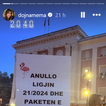
None of them were paid by Athens, were agents of the Islamic Revolutionary Guard Corps, had anti-Semitic leanings, or had any score to settle with the Trump family. They were doing the simplest thing in the world, announcing some basic truths that the traditional media had already found impossible to pronounce.
Therefore, Edi Rama burst out laughing against influencers. After he saw that they, at the post office, with an iPhone or Samsung in hand, proved to be more important than those communication mammoths, whose owners he had declared strategic investors by feeding them endlessly with pieces of tunnels, road tenders, tourist villages. And on his most difficult day, precisely when he needed them most, they seemed like tired prostitutes who could no longer attract any clients.
Perhaps not only for the purpose of manipulation, but also because he did not really understand how a fat army of millions could be defeated by a few little people, the Albanian autocrat rushed to the algorithm manipulated by invisible hands. He probably failed to perceive how the media controlled by him had cultivated for a long time such a great thirst for the truth, for being informed without censorship, for knowing the real Albania.
Confronting this new world derailed the aging autocrat. That's why he began to feed conspiracy theories, produce conspiracy scenarios, denounce enemies who, thanks to the magic of Instagram and the girls who performed there, had brought Albania back to its feet, perhaps without knowing that in this way he was announcing the end of the influence of the old televisions, which had lied in his favor for a decade. ©LAPSI.AL