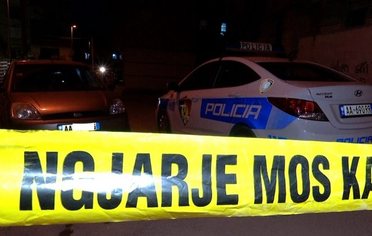
Student protests against poor conditions in Albania's education system have continued in the country's capital, Tirana, while Prime Minister Edi Rama insists he will not resign.
Demonstrators have been calling for Rama to resign in often violent protests since Tuesday. They have set fire to several buildings across the city, including the prime minister's office, ministry buildings and several bank branches.
Dozens of police officers and protesters have been injured during attempts to disperse the crowds using water cannons and tear gas.
"What you are seeing is the boiling point of months of suppressed demands," Albanian journalist Arlis Alikaj told Al Jazeera.
Students have been complaining for months about the high cost of education and their limited employment prospects after graduation.
Afrim Krasniqi, a professor and researcher at the Institute for Political Studies in Tirana, told Al Jazeera that students and youth protested peacefully for almost 3 months, "yet their demands were largely ignored, while the government often responded with discrediting campaigns instead of real dialogue."
He added that the current escalation reflects "disappointment not only with the government itself, but also with the lack of accountability and institutional response."
The protests represent one of the most serious waves of public discontent directed at Rama, who won a fourth term last May but has since faced public anger over corruption allegations involving senior officials.
The unrest in Tirana coincides with a wider wave of student protests across Europe. In France, high school students have spent weeks protesting and blocking schools, demanding more teachers and better learning environments. They have warned that deteriorating school buildings and overcrowded classrooms are harming the quality of education.
Protests against Rama's government began several months ago, sparked by plans to build a luxury resort along Albania's largely untouched southern coast. Jared Kushner, son-in-law of US President Donald Trump, is involved in the project.
Local media reported that protests spread from Tirana to the universities of Elbasan and Shkodra on Wednesday.
Albania is among the Western Balkan economies seeking to reach European living standards. However, the gap with the European Union average remains significant in purchasing power, wages, productivity and the quality of public services. Despite economic progress, the country continues to face challenges, including emigration, regional disparities and the need for stronger institutions and the rule of law.
After Montenegro, Albania stands out as one of the countries that has made the most progress towards full EU membership. However, behind the optimistic political rhetoric, there is growing disillusionment among citizens due to the slow pace of European integration and the lack of tangible improvements in their daily lives.
While opposition groups seek to support the demonstrators and seize the moment to strengthen their position, Alikaj said the protests are being driven by young people and students demanding systemic change.
On Thursday, Rama - who has been prime minister since 2013 - told Reuters: "Regarding the calls for my resignation, governments change through democratic elections. Last year we had elections, not a revolution."
Sokol Lleshi, a lecturer at New York University in Tirana specializing in political science, said that social change is more likely to arise from a broader coalition of different social groups, rather than from mass mobilization limited to university and high school students.
"The removal of the elite from the current ruling political elite may enable institutional means to channel social discontent or dissatisfaction into political and policy changes. However, the current student protest does not appear to replicate the massive university student movement of December 2018 and its effects," Lleshi said.
The student protests that rocked Albania in December 2018 began over rising education costs and forced Rama to dismiss 8 ministers as part of a cabinet reshuffle and announce a package of measures known as the "University Pact."
But some of the students' demands remained unfulfilled.
Lleshi draws some positive conclusions from the past experience of social unrest in Albania.
Albanian society is polarized and unequal, “with hollow intermediary political institutions,” he said, but the legacy of unrest and political confrontation will serve as a “warning to avoid destabilization,” he said. ©Albanian adaptation LAPSI.al