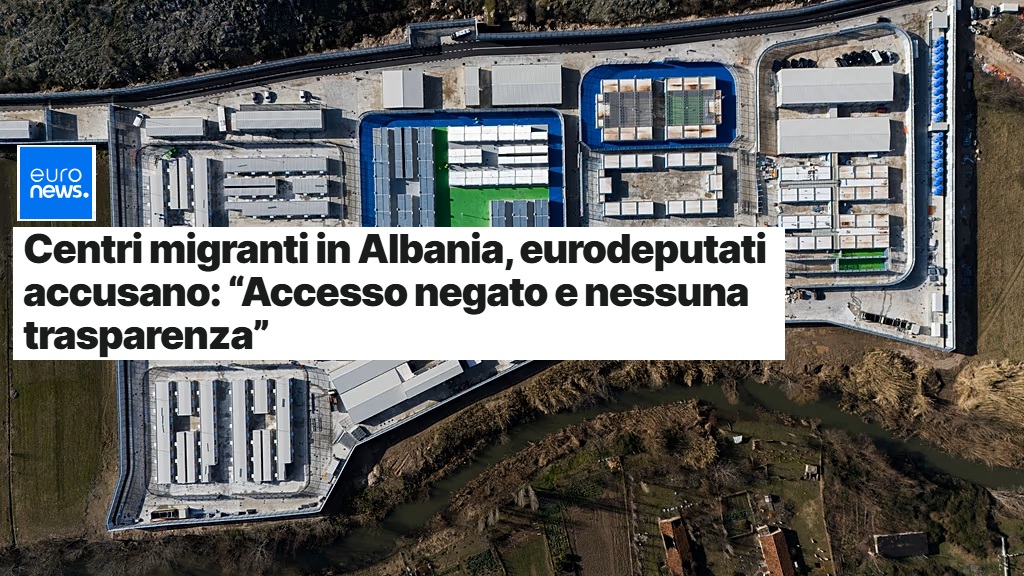
By Euronews .it/ A delegation of MEPs reported being obstructed during an inspection visit to the migrant detention centre in Gjadra, northwestern Albania. The facility is a “cornerstone” of the Italy-Albania agreement on processing migrants “off the high seas” and has been at the centre of intense political and legal controversy across Europe for months.
According to Tineke Strik, a Green/EFA MEP present in the delegation, the centre's staff restricted access to the detention areas and prevented a full inspection of the conditions inside. "Today's visit was very disappointing and embarrassing. The staff really put a lot of obstacles in our way," the MEP said at the end of the inspection.
Visit to Italian Centers in Albania
The European delegation also visited the migrant processing center located in the port of Shëngjin, the first point of arrival for migrants rescued by Italian naval units in the Mediterranean. This facility carries out initial identification, registration and health screening procedures before transfer to the Gjadra center.
The agreement between Rome and Tirana, signed in November 2023 and ratified in 2024, establishes that Italy bears full responsibility for asylum procedures and the management of migrants transferred to Albania. The centers operate under Italian jurisdiction, despite being physically located on Albanian territory.
The protocol applies exclusively to adult males apprehended in international waters by the Italian Navy or Coast Guard. The total cost of the operation is estimated at approximately 160 million euros per year for five years.
MEPs accuse: "We were not allowed in the cell"
The most serious allegations concern the alleged lack of transparency during the inspection visit. Strik reported that MEPs were not allowed to enter the cells or receive detailed information about the functioning of the center.
"We received no information, they did not answer any questions and in fact we were not allowed to enter the cell to see what the situation was like," the MEP explained.
According to the delegation, some migrants also reported difficulties in accessing asylum procedures and a widespread sense of isolation and hopelessness. "The people we spoke to clearly experience difficulties in seeking asylum and many of them see no way out of a failed system," Strik added.
A project overloaded with complaints and legal problems
The Italian project for migrant centers in Albania has encountered many obstacles since its inception. By mid-2025, the centers were housing only a few dozen people, compared to the initial target of 3,000 migrants per month.
The project's costs also sparked political debate. An Italian study found that each seat in the Albanian centers would have cost over 153,000 euros to build, compared to approximately 21,000 euros for similar facilities in Sicily.
Meanwhile, several Italian courts have suspended transfers to Albania, arguing that some countries of origin - including Bangladesh and Egypt - cannot be automatically considered safe under European law.
The Court of Justice of the European Union intervened in August 2025 with a ruling that redefined the criteria for classifying safe countries of origin, further challenging the Italian model for processing asylum abroad.
Complaints from humanitarian organizations
Criticism of the system is not limited to the European Parliament. The International Rescue Committee (IRC), following a visit in early June, also expressed serious concerns about the conditions of migrants being held in Gjadra.
According to the humanitarian organization, many detainees suffer from mental health problems that are not properly treated and live in severe isolation from the outside world. Migrants are also having their mobile phones confiscated upon arrival, drastically limiting contact with family members and lawyers.
The new EU regulation changes the situation
The MEPs' visit comes at a crucial moment for European migration policy. The European Parliament has approved the new Return Regulation, a reform that officially opens up the possibility of setting up return centres abroad outside the European Union.
According to hardline immigration advocates, the new regulatory framework could strengthen initiatives like the one promoted by the Italian government in Albania. However, critics believe the system risks institutionalizing shady practices that potentially undermine migrants' fundamental rights.
In recent weeks, new transfers have reportedly been recorded in Albanian settings, although neither the Italian nor the Albanian government has published updated official data. ©Albanian adaptation LAPSI.al