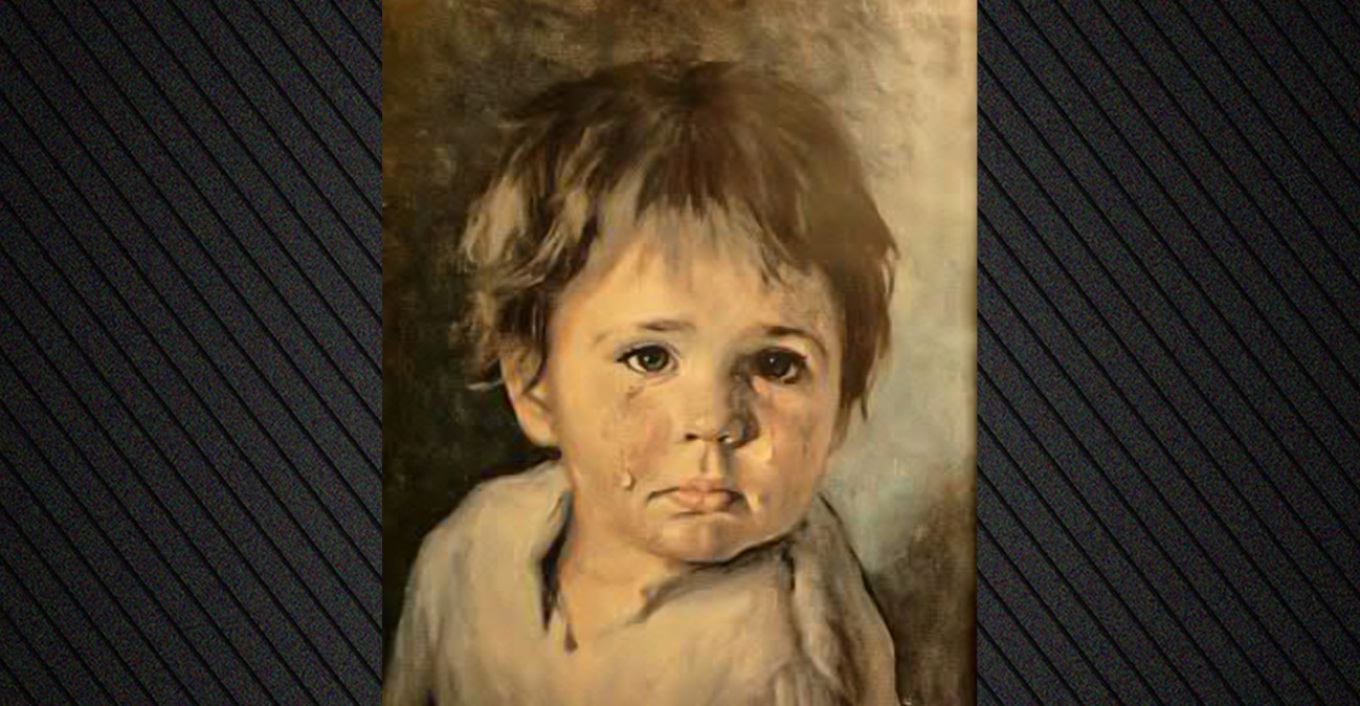
In the middle of the night, in Margaret Thatcher-era England, a house in South Yorkshire suddenly burst into flames. The living room was blackened, the curtains and furniture turned to ash. The owners, Ron and May Hall, lost almost all of their belongings. But amidst the ash and thick smoke, one object stood completely intact: a painting of a little boy with tears in his eyes, looking at them sadly, which had suffered no damage.
This wasn't the first time something like this had happened, but it could be the start of one of the most famous and enduring urban legends in modern history.
The painting “The Crying Boy” was a mass-produced print of a work by Italian painter Bruno Amarillo, who used the pseudonym Giovanni Bragolin. From the 1950s to the 1970s, the painting adorned the living rooms of many homes and was printed in various versions. But the subject was always the same. A boy or girl crying.
Its low price usually attracted buyers from young couples across Europe who were building their homes and wanted a painting to decorate it.
But none of them imagined that these sad faces would soon be associated with a supposed "curse."
The front page of "The Sun" and public panic
The legend took on great proportions in September 1985, when the British tabloid newspaper "The Sun" began to deal with the subject. On September 4, 1985, it published an article that caused great shock, fear and concern.
The title of the article was: "The Burning Curse of the Crying Boy Painting!".
The article was about a painting that "carries" misfortune and causes fires. The text contained statements from a firefighter from Essex, who claimed that in dozens of houses that had been completely destroyed by fires, these paintings were always found among the ruins and were always mysteriously unharmed.
Panic spread quickly. People who had this painting in their homes began to fear for their lives. One woman said that although she considered the painting beautiful, she preferred to throw it away for safety reasons.
Sales opportunity
The Sun newspaper, feeling the pulse of its readers, realized that they wanted more detail on the subject, and the editors saw an opportunity to increase their sales against competition from the Daily Mirror.
The newspaper began publishing new stories all the time, even claiming that the child in the painting had been abused by the painter and that the fires were "the revenge of his soul."
By the end of November 1985, belief in a curse was so widespread that the newspaper invited readers to send in their copies and organized a large public ceremony, burning sacks filled with "Crying Boys" by the River Thames to "break" the curse.
Conspiracy theories and the "Diablo" child
As the years passed, the darkness surrounding the life of the painter Bragolin fueled rumors. In 2000, a book titled "Liverpool of Ghosts" by Tom Schlemen added new and chilling details. According to this theory, the boy who posed for the painting was named Don Boniello.
It was said that the boy accidentally started a fire in Spain that killed his parents. From then on, fires followed him wherever he went, earning him the nickname "Diablo." Legend has it that the boy died in the 1970s when his car burst into flames after a car accident.
The logical explanation behind the mystery
This myth caused so much horror that researchers and scientists wanted to find out what exactly was behind the story of the "crying child" setting fires.
Initially, researcher and journalist David Clarke discovered that the names of people mentioned in the story over the years, such as Don Boniface, were completely non-existent.
However, the definitive answer as to why the paintings were not burned was given by British writer and comedian Steven Punt through his show on BBC Radio 4, in collaboration with construction investigators.
The "magic" was hidden in the production materials
Fireproof varnish: During their mass production, prints were covered with a special varnish containing a fire-resistant substance.
Compressed cardboard: Images were printed on strong, compressed cardboard, a material that is extremely difficult to burn.
The law of gravity: When a fire broke out in the room, the first thing that burned was the string from which the painting was hanging. The result was that the painting fell face down to the floor. Thus, it was protected from the flames and smoke, while the rest of the room was destroyed. ©Albanian adaptation LAPSI.al