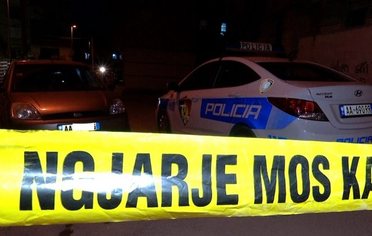
The streets of Tirana and other major cities in Albania have turned into a battlefield, as anti-government protests by students and pupils continue for the third consecutive day.
Serious incidents, attacks with stones and Molotov cocktails against ministries, arson in banks and destruction of government buildings constitute the panorama of tension, while the Police forces have responded with extensive use of tear gas and water cannons.
For his part, Prime Minister Edi Rama made it clear that he will not resign, attributing the violence to the opposition.
Violent clashes in the center of Tirana and attacks on ministries
A new wave of violent incidents began early Thursday afternoon (10/15), when large groups of protesters headed towards the Parliament and other government buildings.
Tensions were centered on the ministries of Education, Finance, Economy, and Infrastructure.
Ministry of Finance and Economy: Protesters, some of whom had their faces covered, threw stones, sticks, metal objects and even metal barriers at the police forces.
Ministry of Education: The most serious damage of the last 24 hours was recorded in this building, where windows were broken and a fire broke out inside the building.
Banks and party offices: Fires broke out in two bank branches, while commercial businesses and the headquarters of the ruling Socialist Party also suffered damage.
According to international news agencies, such as Reuters, tens of thousands of students are participating in the demonstrations. Police have repeatedly intervened to disperse the gatherings, using pressurized water cannons and chemical agents.
Rama: "I will not resign - The opposition is behind the violence"
Despite strong pressure and the spread of incidents to other cities in the country, Albanian Prime Minister Edi Rama appeared determined, categorically declaring to Reuters that he has no intention of submitting his resignation.
Rama argued that Albania's constitutional order and its path towards European integration should not be jeopardized by violent minorities.
In his video message, recorded in front of the damaged College of Europe building in Tirana, the Prime Minister:
He claimed that opposition political parties are inciting and directing acts of destruction.
He declared that acts of violence do not represent the majority of students.
He reconfirmed that his government remains open to dialogue regarding the institutional demands of young students.
From education to the “Flamingo Movement”
The protests initially began over academic and social issues. Students are protesting against:
The high cost of studies and living.
The degraded infrastructure in universities and the lack of sufficient support from the state.
Limited employment opportunities and youth unemployment.
However, gradually the protests took on a genuine anti-government character, with slogans against corruption becoming dominant.
At the forefront of the protests are now collectives such as the "Flamingo Movement".
This movement has organized rallies in recent months against major tourism investment projects in southern Albania, including the controversial project linked to Jared Kushner, son-in-law of US President Donald Trump.